Johann Wolfgang Von Goethes Three Questions for Arts Criticism
Johann Wolfgang von Goethe was born in Frankfurt am Main, Germany, on August 28, 1749. The multifaceted Goethe, in improver to being a author, was also a theoretical physicist, biologist, scholar, painter and statesman. His services to poetry and theater are an integral office of German literature.
Goethe played a primal role in the Weimar Classicism movement, the Sturm und Drang and Romanticism. He is credited with giving the Sturm und Drang movement its first great drama, Götz von Berlichingen, in 1733, and also its showtime great novel, The Sorrows of Immature Werther, in 1774, creating the classical archetype of the romantic hero.
As a child, Goethe received lessons from his father and individual tutors in all the usual subjects of his time and especially in languages, such as Latin, Greek, French, Italian, English and Hebrew, besides as grooming in horsemanship, fencing and dancing.
Goethe enjoyed theater and cartoon, and was deeply interested in literature, devoting much of his time to reading works by Friedrich Gottlieb Klopstock and Homer. Although Goethe studied law from 1765 to 1768 in Leipzig, he was more interested in learning about verse and attended poetry classes past Christian Fürchtegott Gellert.
His first drove of poems, Annette, was published anonymously in 1770.
Past 1771, Goethe had get a lawyer. In an attempt to humanize jurisdiction, Goethe tried cases too vigorously and, equally a result, was reprimanded. He focused on his literary side and created the colorful court drama Götz von Berlichingen. He returned to the practise of police in 1772 and gave the world his masterpiece, The Sorrows of Immature Werther, in 1774.
Afterwards the success of The Sorrows of Young Werther, Goethe was invited to the court of Karl August. Goethe thus moved to Weimar, where he would remain for the balance of his life, occupying a succession of positions until he became the duke's chief adviser.
From 1786 to 1788, Goethe made a trip to Italian republic, which he captured in Italian Journey, published in 1816. He married his lifelong lover, Christiane Vulpius, in 1806, when Napoleon's ground forces invaded the city of Weimar and occupied Goethe'due south house.
From 1793 onwards, Goethe devoted all his time to his literary piece of work. He fell in beloved with Ulrike von Levetzow, who inspired his famous Marienbad Elegy. Goethe considered it his best piece of work.
Some of Goethe'due south most famous works that accept been marked in history are Wilhelm Meister's Apprenticeship, the dramas Iphigenie auf Tauris, Egmont, Torquato Tasso, The Natural Daughter, the fable Reineke Fuchs. Too, Faust Part I, Constituent Affinities, The West-Eastern Divan, his autobiography Aus meinem Leben: Dichtung und Wahrheit and Faust Role Two, completed and published posthumously.
Although Goethe is best known for his literary work, he also had a not bad involvement in science and wrote extensively on color theory and plant morphology. He owned the largest drove of minerals in Europe and his works greatly influenced 19th century naturalists. His works The Metamorphosis of Plants (1790) and Theory of Colours (1810) are among his of import scientific efforts.
Leaving backside volumes of poesy, essays, criticism, dramas, novels, linguistics, and scientific works, Johann Wolfgang von Goethe died on March 22, 1832, in Weimar.
ane) Hermann and Dorothea
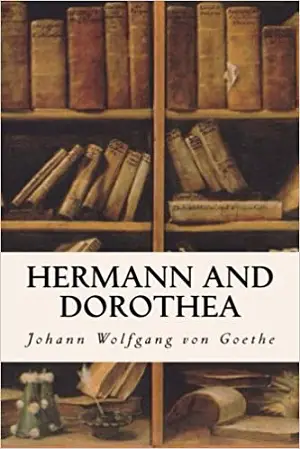
Hermann and Dorotea is the story and feelings of a young man in love with a humble and virtuous girl.
The girl travels in the caravans of Romanian emigrants stripped of their possessions and forced to leave their homes. He is the son of the rich innkeeper owner of the "Golden Panthera leo" who comes to the passage of the caravan to donate some clothes and nutrient. At that moment he meets the girl he falls in beloved with.
Back home he decides to marry her, because now at that place is no other meaning in his life, however his father will non exist willing for his son to marry someone of lesser wealth than his own.
The book is a peculiar sample of what the German language author wanted to plow into a new genre where the bourgeois denizen is a transposition of the old epic hero.
ii) Egmont A Tragedy In V Acts
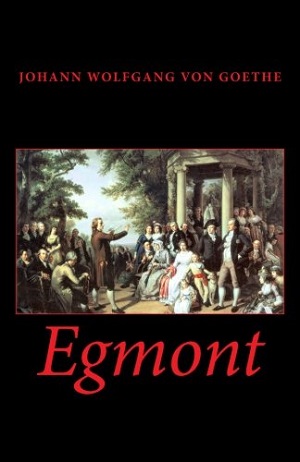
Its beginning edition was published in 1788 and narrates the struggle of the Dutch warrior Count Egmont against the Spanish invader Duke of Alba in the Eighty Years' War. Information technology is set in the time when the netherlands suffered the harsh rule of Catholic Espana.
This work can be considered a political manifesto, since the hero refuses to abscond, driven by his yearning for justice and freedom, even when he is abandoned by his own. He is imprisoned and sentenced to decease, condign a martyr and thus his death is seen every bit a victory against oppression.
If you want to read a play that deals with movements for democracy and nationalism, Egmont A Tragedy In 5 Acts, is the ideal read for yous. Where its protagonist inspires with his inexhaustible fighting spirit for liberty despite all barriers.
three) Faust Part I
Faust is a tragedy of the German writer Goethe, it is his about famous work and is considered one of the great works of world literature. The demon Mephistopheles makes a bet with God, assuring him that he can attract Faust, God's favorite man beingness.
It was published in two parts, in 1808 and 1832. The first part, (Faust. The tragedy's first part), was completed by Goethe in 1806. Its publication in 1808 was followed by a revised edition in 1828-1829, which would exist the last published by the author.
Information technology presents u.s.a. with Faust'south despair, disappointed by his failure to obtain knowledge of nature and the universe by magical means; his pact with Mephistopheles: he will do what Faust wants on earth, and Faust will do the same for him in hell; and his dear for Gretchen.
4) Faust Part II
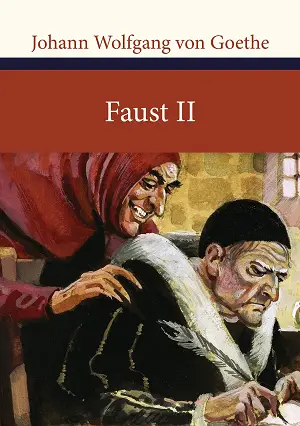
Goethe finished writing the 2nd part of Faust in 1832, the yr of his death. Different the commencement part, the action no longer focuses on Faust's soul, which has been sold to the devil, only on social phenomena such equally psychology, history and politics.
In Faust: The 2nd Part of the Tragedy, the romantic story of the first office is ready aside to initiate a new cycle of adventures in Faust's life after Gretchen'southward death. Information technology introduces us to our protagonist together with Mephistopheles traveling through time and space, interacting with mythological figures.
In the stop, Faust overcomes the wiles of the devil and, upon his decease, instead of the devil taking his soul, a host of angels takes him to heaven.
5) Iphigenia in Tauris
Iphigenia in Tauris is Goethe's adaptation of Euripides' ancient Greek tragedy, Iphigeneia en Taurois. This reworking was completed in 1786, and has captivated for its brilliant limerick and psychological depth, encompassing themes such as personal integrity and responsibility.
In the play Iphigenia has been serving the goddess Diana for many years as a priestess in her temple on the island of Tauris, although she does and so against her will, as she feels lonely and longs for some event to occur that will allow her to return to Greece and exist reunited with her family.
When her blood brother Orestes arrives on the island and must exist sacrificed to the goddess, Iphigenia must cull between duty and her own desires. In the stop, Iphigenia manages to avoid the deadly outcome, convincing the king to give them their freedom and render to Greece in peace.
6) The Maxims and Reflections
This work comprises more grand Maxims and Reflections by Goethe, one of the giants of world literature. Information technology is a collection of thoughts and observations covering a wide multifariousness of subjects, such as ideals, literature, fine art and the natural sciences. Information technology could exist considered a collection of "wise sayings".
Some may exist considered true by nearly readers, as they are statements with which near of u.s. would readily agree. Others are only personal behavior, which shed calorie-free on what the author held to be true, giving u.s. an idea of the type of reasoning Goethe employed.
Although some maxims may seem pretentious, complicated or exaggerated, the truth is that many of them speak to united states of the nature of man and his concerns.
7) The Sorrows of Werther
The Sorrows of Werther (German: Dice Leiden des jungen Werthers) is a semi-autobiographical epistolary novel by Johann Wolfgang von Goethe.
The novel'south protagonist, Werther, is a sensitive and passionate immature man who falls madly in love with Charlotte, a woman engaged to another man.
Werther is a handsome homo who arouses the interest of many other women, but he is in love with Charlotte, who does not love him, and despite the intense pain of unrequited honey, Werther develops an intimate friendship with her.
The primary scene mainly represents Goethe'south German translation of a office of the Ossian cycle of poems which, although originally considered translations of ancient works, were subsequently discovered to have been written by James Macpherson.
viii) Wilhelm Meister
Wilhelm Meister (High german: Wilhelm Meisters Lehrjahre) is the German author's 2d novel, published in 1795-96.
While his outset novel, The Sorrows of Young Werther, presented a hero driven to suicide by despair, the eponymous hero of this novel travels a path of self-realization.
The story centers on Wilhelm's effort to escape from what he sees as the empty life of a bourgeois businessman. After a failed romance with the theater, Wilhelm commits himself to the mysterious Belfry Society, composed of bully aristocrats.
Other books that have used a similar scheme to this novel have been called Bildungsroman ("novels of germination"), although Wilhelm's "Bildung" ("education" or "formation of character") is ironized by the narrator in numerous passages.
Classic Authors Books
| Agatha Christie Books
| Alexandre Dumas Books
| Aristotle Books
| Arthur Conan Doyle Books
| Brothers Grimm Books
| Charles Darwin Books
| Charles Dickens Books
| Charles Perrault Books
| Dante Alighieri Books
| Edgar Allan Poe Books
| Franz Kafka Books
| Friedrich Nietzsche Books
| Fyodor Dostoevsky Books
| H. Thou. Wells Books
| H. P. Lovecraft Books
| Hans Christian Andersen Books
| Honoré de Balzac Books
| Immanuel Kant Books
| James Joyce Books
| Jane Austen Books
| Jules Verne Books
| Karl Marx Books
| Leo Tolstoy Books
| Lewis Carroll Books
| Mark Twain Books
| Marquis de Sade Books
| Oscar Wilde Books
| Plato Books
| Robert Louis Stevenson Books
| Sigmund Freud Books
| Victor Hugo Books
| Virginia Woolf Books
| Voltaire Books
| William Shakespeare Books
Source: https://www.infobooks.org/authors/classic/johann-wolfgang-von-goethe-books/
0 Response to "Johann Wolfgang Von Goethes Three Questions for Arts Criticism"
Post a Comment